How to Clean Your Refrigerator (and Keep Your Food Safe)
Reviewed by The Small Crew editorial team against CDC, USDA, Penn State Extension, and Iowa State University Extension guidance.
The short answer
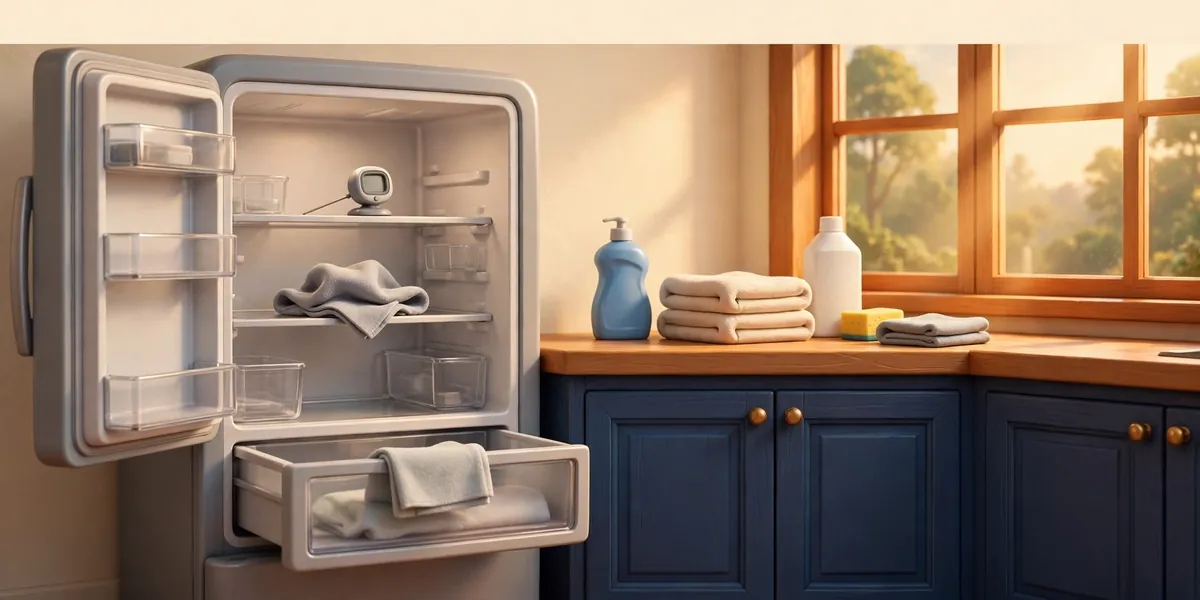
A refrigerator is a food-safety appliance first and a storage box second. It works by holding food at 40°F or below, cold enough to slow the bacteria that cause foodborne illness — but not cold enough to stop all of them. Some bacteria, notably Listeria monocytogenes, can still grow and multiply at refrigerator temperatures [2] [3]. So a fridge needs two things: the right temperature, and regular cleaning. The method below follows the CDC's own 5-step guide [1]: empty it and sort it, wash the shelves and walls with hot, soapy water, sanitize with a weak bleach solution, and put food back where it stays coldest. A full deep clean every three to four months is enough for most households [5].
Why a dirty fridge matters
Bacteria grow most rapidly between 40 and 140°F — the "Danger Zone" — some doubling in number in as little as 20 minutes. A refrigerator set at 40°F or below will protect most foods [2]. That is why the temperature matters more than how the fridge looks: pathogenic bacteria — the kind that cause foodborne illness — do not generally affect the taste, smell, or appearance of a food. In other words, you cannot tell that a pathogen is present [2]. A fridge can look clean and still hold food that is no longer safe, and a spill left to dry on a shelf is a place for bacteria to grow. Cleaning is the other half of the job: a clean and sanitized refrigerator is less likely to harbor dangerous bacteria that can cause illness [3].
What doesn't work
- Sanitizing without cleaning first. The bleach solution is a sanitizer, not a cleaner. It works after the dirt and food residue are gone — the CDC's step is to sanitize only after cleaning with hot, soapy water [1]. Spraying bleach on a dirty shelf does not do the job.
- Solvent cleaners and abrasives. Avoid solvent cleaning agents, abrasives, and cleansers that may impart taste to food or ice cubes, or damage the interior finish of your refrigerator [2]. Penn State puts it the same way: avoid cleaning solvents in the refrigerator because they could release chemical fumes that can transfer into food and ice, making them unsafe to eat [3]. Dishwashing liquid and water work well to clean the interior [3].
- Judging safety by look or smell. As above, you cannot tell a pathogen is present from how food looks or smells [2]. A smell in the fridge is a cleaning problem — it does not by itself tell you the food is unsafe, and the absence of a smell does not tell you it is safe.
The steps that do work
1. Before you start: the cooler and the 2-hour rule
Put perishables — milk, cheese, yogurt, meat, and eggs — in a cooler with ice or ice packs to keep them cold while you clean [4] [5]. Don't leave foods that need to be kept in the refrigerator out for more than 2 hours [1]. If you think the job will take longer than two hours, the cooler is not optional [4]. Check the temperature while you are at it: the refrigerator should maintain a temperature of 40°F or below to keep food at a safe temperature [3]. An appliance thermometer kept in the refrigerator is the way to verify it [2].
2. Empty it and sort it
Take everything out. Throw out food that has spoiled or expired, and leftovers more than four days old [4] [5]. A general rule of thumb for refrigerator storage for cooked leftovers is 4 days [2]. Once a week, make it a habit to throw out perishable foods that should no longer be eaten [2]. Date markings like Best By and Use By dates are placed on products by food manufacturers; except for infant formula, these dates are an indication of food quality, not food safety [4]. If a food was stored in a reusable container, wash the container with hot, soapy water before reusing it [1].
3. Wash the shelves, drawers, and walls
Take out shelving, drawers, and any other removable parts. Wash them by hand with hot, soapy water, and dry them with a clean towel [1]. Wipe the inside of the empty refrigerator with hot, soapy water, then wipe with clean water to rinse off the soap, and dry with a clean towel [1]. Don't forget to wipe inside the doors and any drawers that cannot be removed [1]. Wipe the interior walls of the refrigerator and the gasket with warm soapy water and rinse them with clear water [3]. Wipe up spills right away whenever they happen — clean surfaces thoroughly with hot, soapy water, then rinse [2].
Glass needs care. Don't run cold glass shelves or drawers under hot water because the glass could crack. Let them come to room temperature first [1].
4. Sanitize with a weak bleach solution — after cleaning, not instead of it
After cleaning the refrigerator with hot, soapy water, use a solution of 1 tablespoon of unscented liquid bleach in 1 gallon of water to sanitize your refrigerator [1] [4] [7]. Sanitizing is optional in the CDC's guide, and it comes after cleaning, never before it [1]. Rinse the surfaces with the sanitizing solution after washing [4].
Do not confuse this with our mold article. This is a much weaker solution than the one in our bathroom mold article, which uses 1 cup of bleach per gallon of water. The fridge sanitizing solution is 1 tablespoon per gallon — one tablespoon, not one cup. Do not use the mold dilution here.
5. The parts people skip: the gasket and the coils
The rubber gasket around the door traps food and moisture — wipe it with warm soapy water and rinse it with clear water, every time you clean [3] [4]. The front grill should be kept free of dust and lint to permit free air flow to the condenser [2]. Keep the refrigerator coils and front grill free of lint by vacuuming them every 3–4 months to keep the unit working efficiently [3] — a brush works too for the condenser coil [2]. Once a year, clean the back and bottom of the fridge — this helps it to operate efficiently [5]. Wipe the exterior with water and dishwashing liquid [3].
6. Put it back together — where food goes, and the 40°F check
Wipe food and drink containers with hot, soapy water before returning them to the clean refrigerator [1]. Then put food back by temperature zone, not by habit:
- Lowest shelf: raw meat, poultry, and seafood, in a sealed container or wrapped securely, so meat juices cannot drip onto other foods [6]. Raw meat, poultry, and seafood should be in a sealed container or wrapped securely to prevent raw juices from contaminating other foods [2].
- Middle shelves: ready-to-eat foods like salads, desserts, or leftovers [6].
- Back of the refrigerator: milk and eggs, so they stay cold [5]. Eggs should be stored in the carton on a shelf [2].
- Door shelves: condiments and salad dressings only — that is the warmest part of the refrigerator. Do not store eggs or milk here [6]. Don't store perishable foods on the door; the temperature of the storage bins on the door fluctuates more than the temperature in the cabinet [2].
- Crisper drawers: fruits and vegetables. Vegetables prefer higher humidity and fruits lower humidity, so adjust the drawer controls accordingly [6].
Group similar foods together as you put them back, and label and date all foods [5]. Finally, check the temperature again: make sure the refrigerator temperature is 40°F or below, so your food is safe to eat [5]. Wash your hands with soap and water once you've finished cleaning [1]. Use hot, soapy water to wipe kitchen counters that held food, drinks, refrigerator parts, and any cleaning materials, and wash any towels you used to clean and dry the refrigerator before using them again [1].
Lingering smells after a power outage or flood
If your fridge or freezer smells bad after a power outage or flood, clean and sanitize it first using the steps above, then deal with the smell [7]. Rinse everything, then wipe with the same sanitizing solution — 1 tablespoon of unscented bleach per gallon of water [7]. Leave the door open for about 15 minutes to let it dry and air out, and keep small children out of the kitchen during that time [4] [7]. If the smell is still there, wipe the inside with equal parts vinegar and water [7]. That vinegar wipe is an odor step, after cleaning and sanitizing — it is not a disinfectant. If odors remain after all of that, try a commercial cleaner and follow the manufacturer's instructions; if that doesn't work, you may need to replace the appliance [7].
When to call a professional or replace the unit
A refrigerator that cannot hold 40°F or below is not keeping food safe — the temperature rule is the test [2] [3]. If your thermometer shows the fridge will not stay at or below 40°F, have it serviced; a fridge that cannot be fixed should be replaced rather than trusted with perishable food. If odors cannot be removed after the full cleaning, sanitizing, and airing-out routine, the refrigerator or freezer may need to be discarded [7]. If you do discard an old refrigerator or freezer, remove the door first so children cannot get trapped inside [7].
What you'll need
We have not tested these products ourselves, and this is not a review — these are the product types that match the method above, listed so you know what to look for. There are no affiliate links here and no prices listed.
| What it is | What it does | What to look for |
|---|---|---|
| Refrigerator thermometer | Verifies the fridge is holding 40°F or below | An appliance thermometer designed to be accurate at cold temperatures; kept in the refrigerator |
| Dish soap | The cleaning agent for washing shelves, drawers, and walls | A plain liquid dishwashing soap for use with hot water; do not use solvent cleaners or abrasives |
| Unscented household liquid bleach | The sanitizer, after cleaning | Unscented liquid bleach only; mixed at 1 tablespoon per gallon of water — never the 1 cup per gallon mold dilution |
| Clean towels | Drying shelves, drawers, and the interior | Clean towels, washed before reuse (microfiber cloths work well) |
| Cooler with ice packs | Holds perishables cold while you clean | A cooler plus ice or ice packs, for any job that will take more than two hours |
| Baking soda | Odor control only — not a sanitizer | An open box on a shelf to keep the fridge smelling fresh; or baking soda and water for odor wipe-downs |
| Vacuum cleaner with brush attachment | Keeps coils and the front grill free of lint | A vacuum (or brush) for the condenser coil and front grill, every 3–4 months |
A note on availability: these product types are widely available in the US; the product type is what matters, not the brand name.
Prevention checklist (keeping it clean)
- Wipe up spills right away with hot, soapy water, then rinse [2]
- Once a week, throw out perishable foods that should no longer be eaten [2]
- Keep cooked leftovers no more than four days [2] [3]
- Deep clean the refrigerator every three to four months [5]
- Vacuum the coils and front grill every 3–4 months [3]
- Keep an open box of baking soda on a shelf to keep the fridge smelling fresh [2] [3]
- Check the temperature with an appliance thermometer — 40°F or below [2] [3]
- Label and date foods as you put them back [5]
Sources
- Centers for Disease Control and Prevention — "How to Clean Your Refrigerator Because of a Food Recall" (the accessible version of the CDC's "5 Steps to Clean Your Refrigerator" guide, FoodSafety.gov). — printable version.
- U.S. Department of Agriculture, Food Safety and Inspection Service — "Refrigeration and Food Safety" (fact sheet, revised November 2005). Archived copy.
- Penn State Extension — "Refrigerator Refresher".
- Iowa State University Extension and Outreach, Spend Smart Eat Smart — "A Fresh and Clean Refrigerator" (January 29, 2024).
- Iowa State University Extension and Outreach, Words on Wellness — "Spring Clean Your Refrigerator" (May 24, 2022).
- Iowa State University Extension and Outreach, Words on Wellness — "Refrigerator Tetris — Where should the food go?" (September 20, 2022; source: USDA).
- Iowa State University Extension and Outreach, Words on Wellness — "Removing Odors from Fridges and Freezers" (November 2025; source: USDA) and AnswerLine — "Steps to Remove Odors from Refrigerators and Freezers" (source: USDA Food Safety and Inspection Service "Removing Odors from Refrigerators and Freezers"; reviewed and updated 11/2025).
This article is general information, not professional food-safety or appliance-repair advice. If you are unsure about a product label, a persistent food-safety problem, or a refrigerator that will not stay cold, consult a licensed professional or a health professional in your area. Product names are mentioned as examples of a product type, not as endorsements. We have not tested these products ourselves.
Keep reading
 Verified
How to Get Rid of Ants in the Kitchen (and When to Call a Pro)
Step-by-step: find what the ants want, clean up, seal the way in, use bait instead of spray, and know when to call a licensed professional. Based on university extension research.
 Verified
How to Get Rid of Cockroaches in Your Kitchen (and Keep Them Out)
Find where they hide with sticky traps, take away food and water, seal the gaps, then bait — baits work better than sprays, and foggers make things worse. Based on University of California IPM guidance.
 Verified
How to Clean Mold and Mildew in Your Bathroom (and Keep It From Coming Back)
Moisture first, scrubbing second: check the size, protect yourself, fix the leak, scrub with detergent and water, and keep it from coming back. Based on EPA, CDC, and NC State Extension guidance.