How to Clean Mold and Mildew in Your Bathroom (and Keep It From Coming Back)
Reviewed by The Small Crew editorial team against EPA, CDC, and NC State Extension guidance.
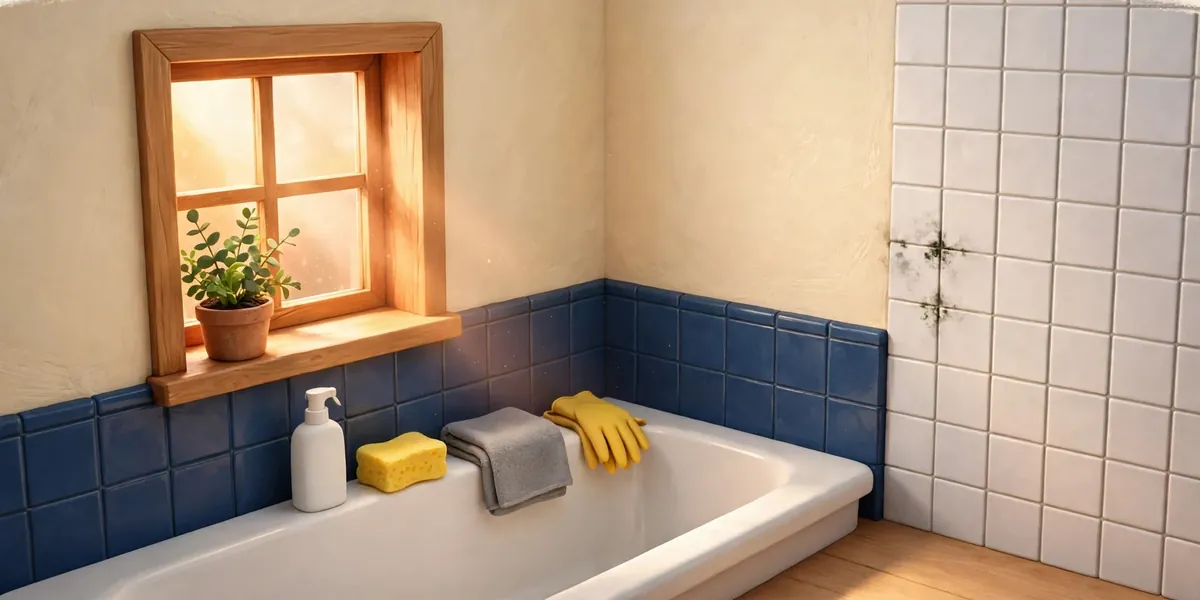
Bathroom mold is a moisture problem first and a cleaning problem second. Scrubbing alone will not fix it: if the moisture stays, the mold comes back. What works is a short sequence — check the size, protect yourself, fix the moisture, scrub with detergent and water, dry completely, and change the routine that kept the room wet.
The short answer
- Check the size: if the moldy area is less than about 10 square feet — less than roughly a 3-foot by 3-foot patch — you can usually handle it yourself.
- Protect yourself: an N-95 respirator that fits properly, long gloves to the middle of the forearm, and goggles without ventilation holes.
- Fix the moisture first: a dripping tap, a leak, or a fan left off is usually why the mold is there.
- Scrub hard surfaces with detergent and water, then dry them completely.
- Call a professional if the patch is large, keeps coming back, you can smell mold but cannot see it, or the HVAC system may be contaminated.
Why mold shows up in the bathroom
Mold needs four things to grow: a food source, moisture, the right temperature, and oxygen [3]. A bathroom supplies all four every day — soap residue and dust on grout and caulk are food, steam is moisture, and the room is warm. The U.S. Environmental Protection Agency puts it plainly: "The key to mold control is moisture control" [1]. Mold spores are part of the natural environment and cannot be eliminated; they float through indoor and outdoor air, invisible to the eye, and only grow when they land on a wet surface [1]. That is why dark spots can appear along grout lines even on tile that looked clean for months: something changed the moisture — a fan left off, a dripping tap, grout staying damp.
Mold can cause health problems: molds produce allergens, irritants, and in some cases potentially toxic substances, and inhaling or touching mold may cause allergic reactions or trigger asthma attacks in people with asthma who are allergic to mold [1]. People with a chronic lung condition or a weak immune system should avoid buildings contaminated with mold [2]. A small patch on the grout is not an emergency — but the cleanup is worth doing properly, with protection, rather than ignored.
What doesn't work
- Killing it without removing it. "Dead mold may still cause allergic reactions in some people, so it is not enough to simply kill the mold, it must also be removed" [1]. Scrubbing — the physical removal — is the step that matters.
- Bleach as the routine answer. Chlorine bleach is not recommended as a routine practice during mold cleanup [1]. Detergent, water, and a brush do the actual work.
- Painting or caulking over mold. Do not paint or caulk moldy surfaces; clean up the mold and dry the surfaces first — paint applied over mold is likely to peel [1].
- Cleaning without fixing the moisture. "If you clean up the mold, but don't fix the water problem, then, most likely, the mold problem will come back" [1].
The steps that do work
1. Check the size first
If the moldy area is less than about 10 square feet — less than roughly a 3-foot by 3-foot patch — in most cases you can handle the job yourself [1]. The CDC gives the same threshold: mold covering more than 10 square feet is the point to consider a professional [2]. If the patch is larger, if there has been a lot of water damage, or if the water came from sewage or another contaminated source, stop here and call a professional [1].
2. Protect yourself and ventilate the room
Wear an N-95 respirator that fits properly, following the instructions supplied with it — the CDC advises buying an N-95 mask if you plan to clean up mold [2]. Wear long gloves to the middle of the forearm and goggles without ventilation holes [1]. Open a window or run the bathroom exhaust fan so air moves out of the room; if you use a disinfectant, always ventilate and exhaust the air to the outdoors [1]. If you have health concerns, consult a health professional before starting cleanup [1]. People with mold allergies, asthma, a chronic lung condition, or a weak immune system should not do mold cleanup themselves [2].
3. Fix the moisture first
This is the step that decides whether the mold stays away. Check for a dripping tap, a leaking supply line or drain, and water pooling where the tub meets the wall, and fix plumbing leaks as soon as possible [1]. Run the bathroom fan — or open a window — when showering, and leave it running for a while after [1]; not using an exhaust fan when bathing is a common source of excess indoor moisture [3]. Dry water-damaged areas and items within 24 to 48 hours to prevent mold growth [1], and keep indoor humidity below 60 percent, ideally between 30 and 50 percent relative humidity [1] [3].
4. Scrub hard surfaces with detergent and water, then dry completely
This is the EPA's core cleanup method: "Scrub mold off hard surfaces with detergent and water, and dry completely" [1]. Mix a mild household detergent with water, work along the grout lines with a stiff brush and across tile, tub, and glass with a cloth or sponge, rinse with clean water, then dry the area completely — a towel, a squeegee on shower walls, and the exhaust fan all help. Expect staining to remain: mold may cause staining and cosmetic damage, and it may not be possible to clean an item so that its original appearance is restored [1]. A grout line that is clean but still discolored is a finished job, not a failed one.
5. If you use bleach, use it diluted — and never mix it
Bleach is optional, not the routine method [1]. If you decide to use it on a hard surface after scrubbing, dilute it to no more than 1 cup of household liquid bleach per 1 gallon of water [2], and never use it straight from the bottle. Never mix bleach with ammonia or any other cleaning product — mixing a chlorine bleach solution with cleaners containing ammonia can produce toxic fumes [1], and the CDC's rule is the same: never mix bleach, or products containing bleach, with ammonia, or products containing ammonia — read the label on any product to see what it contains [2]. Ventilate and exhaust the air to the outdoors while you use it [1]. Do not use fungicides made for outdoor use indoors [1].
6. Deal with what cannot be cleaned
Porous materials — such as ceiling tiles and carpet — may have to be thrown away if they become moldy, because mold can grow into their empty spaces and crevices and may be impossible to remove completely [1]. Mold that has grown into a caulk bead usually cannot be scrubbed out: remove the old bead, clean and dry the joint underneath, and apply new caulk — never apply new caulk over mold [1]. If you are unsure about how to clean an item, or if it is expensive or of sentimental value, consult a specialist [1].
When to call a professional
DIY is right for a small bathroom patch. Call a professional if:
- The mold covers more than about 10 square feet, or there has been a lot of water damage [1] [2].
- The water or mold damage was caused by sewage or other contaminated water [1].
- You can smell mold but cannot see it. A musty smell with no visible source can mean hidden mold behind drywall, wallpaper, or panelling, around pipes inside walls, or above ceiling tiles. Investigating hidden mold requires caution, so consider hiring an experienced professional [1].
- The mold keeps coming back in the same place after proper cleaning — that usually means water is getting in behind the surface.
- You suspect the heating, ventilation, and air conditioning system is contaminated. Do not run the system, as it could spread mold through the building [1].
A professional should have experience cleaning up mold — check references, and ask the contractor to follow the EPA's mold remediation guidelines [1]. Before the job is considered finished, the water problem must be completely fixed, visible mold and moldy odors should be gone, and a revisit shortly after cleanup should show no signs of water damage or mold growth [1].
Our free contractor directory is opening soon. You'll be able to find licensed mold remediation professionals near you.
Back to the homepageWhat you'll need
We have not tested these products ourselves, and this is not a review — these are the product types that match the method above, listed so you know what to look for. There are no affiliate links here and no prices listed.
| What it is | What it does | What to look for |
|---|---|---|
| Mild household detergent | The cleaning agent for scrubbing mold off hard surfaces | A plain detergent for use with water; check the label — do not use a detergent containing ammonia if you also plan to use bleach |
| Stiff brush / grout brush | The friction that removes mold from grout lines and tile | A narrow brush that fits along grout lines; a cloth or sponge for smooth surfaces |
| N-95 respirator | Limits breathing in mold spores during cleanup | A respirator that fits properly; follow the fitting instructions on the package |
| Long rubber gloves | Keeps mold and cleaning solutions off your hands | Gloves reaching to the middle of the forearm; natural rubber, neoprene, nitrile, polyurethane, or PVC if using a disinfectant |
| Goggles without ventilation holes | Keeps mold spores out of your eyes | Goggles with no vent holes |
| Household liquid bleach (optional) | A disinfectant, only if you choose to use one after scrubbing | Diluted to no more than 1 cup per gallon of water; never mixed with ammonia or other cleaners |
| Squeegee | Dries shower walls and glass after use so moisture does not sit | A blade that fits the shower wall; used after every shower |
| Humidity meter | Measures indoor relative humidity against the 30–50 percent target | An inexpensive moisture or humidity meter |
| Bathroom exhaust fan | Removes steam at the source and exhausts it outdoors | A fan that vents to the outdoors, run during and after showers |
A note on availability: these product types are widely available in the US; the product type is what matters, not the brand name.
Prevention checklist (keep it from coming back)
- Run the bathroom fan or open a window every time you shower, and leave it running after
- Dry shower walls and surfaces after use; do not leave the room steamy for hours
- Fix drips and leaks as soon as you notice them
- Keep indoor humidity below 60 percent, ideally between 30 and 50 percent
- Clean the bathroom more frequently — in places that are often or always damp, increasing ventilation and cleaning more frequently will usually prevent mold from recurring, or at least keep it to a minimum [1]
- If mold returns in the same place after cleaning, look for water behind the surface before scrubbing again
Sources
- A Brief Guide to Mold, Moisture, and Your Home — U.S. Environmental Protection Agency.
- Preventing Mold — Centers for Disease Control and Prevention.
- Preventing Mold in Your Home — NC State Extension (authors: University of Georgia Extension; NC State).
This article is general information, not professional mold-remediation or medical advice. If you are unsure about a product label, a structural issue, a persistent mold problem, or a health concern, consult a licensed professional or a health professional in your area. Product names are mentioned as examples of a product type, not as endorsements. We have not tested these products ourselves.
Keep reading
 Verified
How to Clean Your Refrigerator (and Keep Your Food Safe)
Empty it and sort it, wash with hot, soapy water, sanitize with a weak bleach solution, and put food back where it stays coldest — the CDC's 5-step method, plus the 40°F check. Based on CDC, USDA, Penn State and Iowa State Extension guidance.
 Verified
How to Test and Balance Your Pool Water
Test free chlorine and pH at least twice a day, keep them in the CDC's ranges, fix alkalinity before pH, change one thing at a time, and handle pool chemicals safely. Based on CDC and Pool & Hot Tub Alliance guidance.
 Verified
How to Get Rid of Ants in the Kitchen (and When to Call a Pro)
Step-by-step: find what the ants want, clean up, seal the way in, use bait instead of spray, and know when to call a licensed professional. Based on university extension research.