How to Test and Balance Your Pool Water
Reviewed by The Small Crew editorial team against CDC, National Pesticide Information Center, and Pool & Hot Tub Alliance guidance.
The short answer
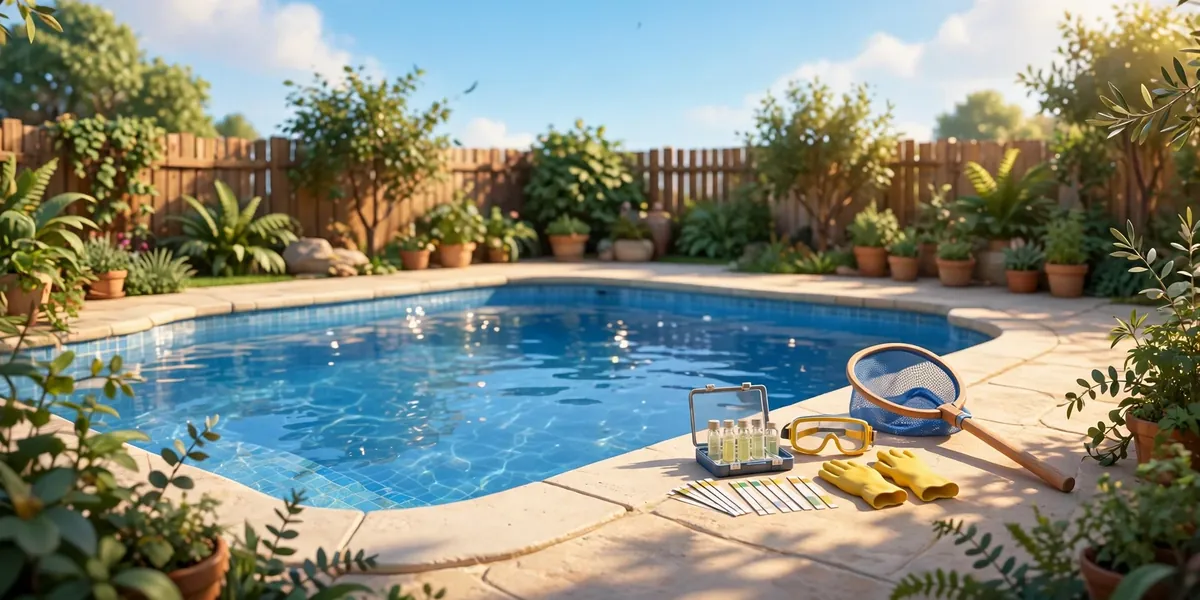
Pool water stays safe when two numbers are right — free chlorine and pH — and you check them often. The CDC calls chlorine and pH "the first defense against germs that can make swimmers sick," and it recommends testing both at least twice a day [1]. For a home pool, the CDC's numbers are pH 7.0–7.8 and free chlorine of at least 1 part per million (ppm) — at least 2 ppm with cyanuric acid, a chlorine stabilizer [1]. Three supporting numbers — total alkalinity, calcium hardness, and stabilizer level — keep pH steady and protect the pool itself; those are industry guidance, not CDC figures, and this article labels them that way. The routine is simple: test first, change one thing at a time, retest, and follow the product label — never guess a dose. The dangerous part is the chemicals: never mix them, read the label before every use, wear protection, and store them locked, dry, and cool.
Why testing matters
Chlorine kills germs, but not instantly. At the CDC's recommended levels, it kills most bacteria, such as E. coli O157:H7, in less than a minute — but a few germs are moderately (Giardia, Hepatitis A) to very (Cryptosporidium, often called "Crypto") chlorine-tolerant, and disinfection takes longer when cyanuric acid is in the water [1]. A few germs can survive for long periods in even well-maintained pools [1]. Water can look clear and still carry germs that chlorine kills slowly, so the numbers matter more than the look of the water.
The two numbers that matter most
| What | CDC target — home pool | CDC target — hot tub |
|---|---|---|
| Free chlorine | At least 1 ppm; at least 2 ppm if using cyanuric acid or chlorine products that contain it (such as dichlor or trichlor) [1] | At least 3 ppm; do not use cyanuric acid in hot tubs [1] |
| pH | 7.0–7.8 [1] | 7.0–7.8 [1] |
pH is the balance point: the 7.0–7.8 range best balances killing germs, pipe life, and swimmers' comfort [1]. As pH goes up, chlorine's ability to kill germs decreases, especially above 8.0; as pH goes down, especially below 7.0, chlorine kills better but pool pipes are more likely to corrode or break down [1].
The three supporting numbers
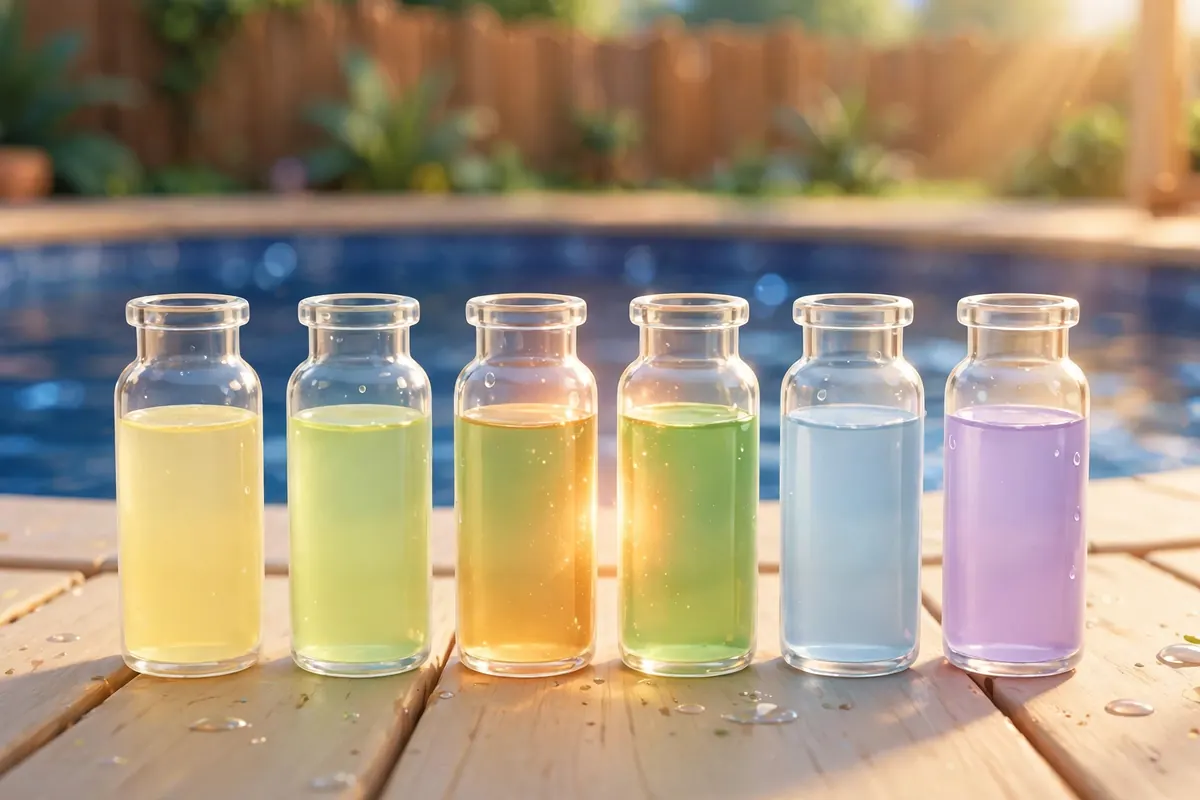
These three are industry guidance from the Pool & Hot Tub Alliance (PHTA), not CDC figures. The CDC's home-pool guidance sets no numbers for them — only chlorine and pH [1]. The CDC's public-pool code, the Model Aquatic Health Code (MAHC), sets wider outer bounds for public venues, noted below so you can see where the sources disagree [8].
| What | Industry guidance (PHTA) | What the CDC's public-pool code says | What it does |
|---|---|---|---|
| Total alkalinity | About 80–120 ppm [9] | The MAHC allows 60–180 ppm [8] | Buffers pH — it neutralizes hydrogen ions, so pH does not swing wildly when small amounts of acid or alkali are added [8]. Too low, and pH changes rapidly and can cause etching and corrosion; too high, and pH becomes difficult to adjust, with cloudy water, weaker disinfection, scale, and filter problems [8]. |
| Calcium hardness | About 200–400 ppm [9] | The MAHC caps calcium at 2,500 ppm — a far wider outer bound, not a target [8]. The MAHC's own guidance prefers 200–400 ppm for plaster pools (80–200 ppm for vinyl or fiberglass) [8]. | Too much calcium causes cloudiness and scale; too little, especially with low pH or low alkalinity, makes "aggressive water" that can dissolve calcium carbonate from plaster and metal parts such as rails, ladders, and light fixtures [8]. |
| Cyanuric acid (stabilizer) | About 30–50 ppm for outdoor pools [9] | The MAHC caps stabilizer at 90 ppm [8] | Shields chlorine from sunlight — stabilizer slows the breakdown of chlorine in sunlight [6]. But it also slows disinfection: disinfection times are longer when stabilizer is present [1]. Do not use stabilizer in hot tubs [1]. |
How to test
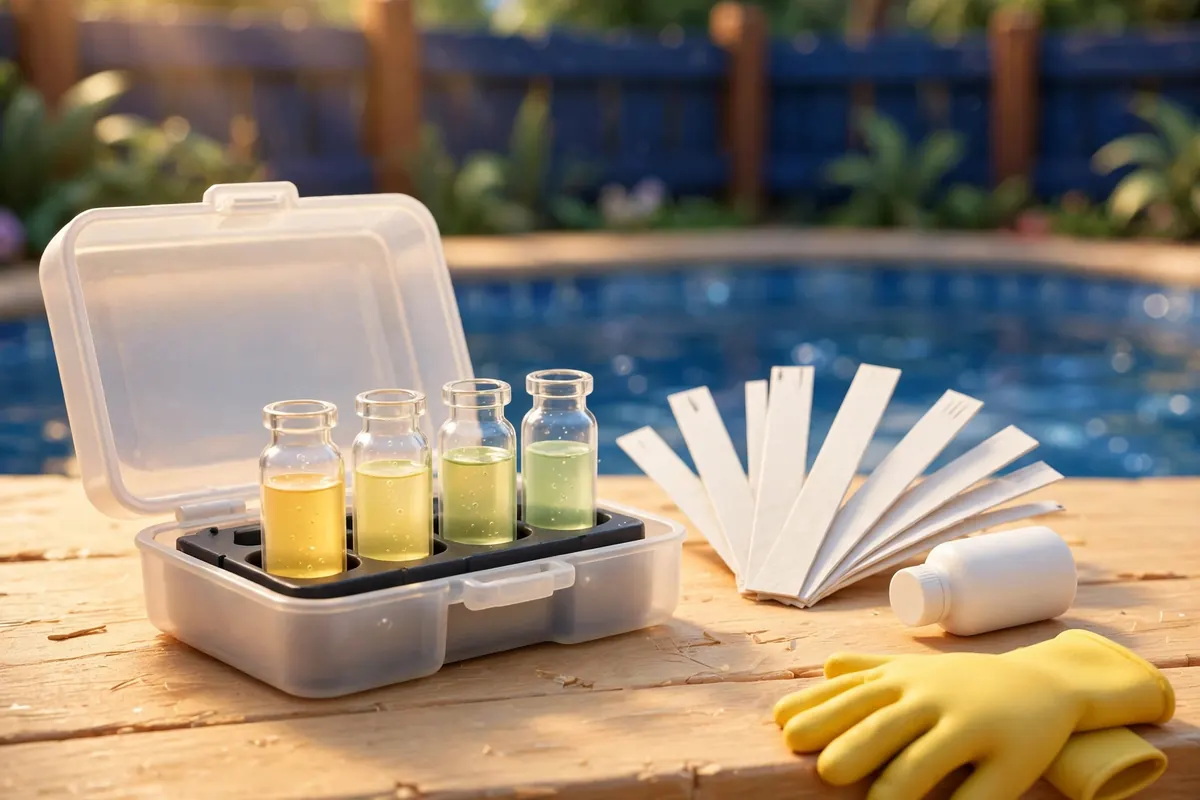
Test chlorine and pH at least twice a day — more often when the pool is being used by a number of people [1].
Use a DPD test kit for the most accurate result. Test strips also work, but they are less accurate [1]. Whichever test you use, always follow the manufacturer's directions [1].
Watch out for the false-low trap. If the chlorine in the water you sampled is more than 10 ppm, the test might partially or totally bleach out, giving a false low or 0 ppm result [1]. A zero reading right after a large chlorine addition does not necessarily mean there is no chlorine — check the kit's instructions for measuring above its limit, for example by diluting the sample or using higher-range strips [2].
Check the supporting numbers less often. Chlorine and pH change fastest, so test those most often. The CDC's public-pool code tests total alkalinity weekly and calcium hardness and cyanuric acid monthly [8] — a sensible rhythm for a home pool too.
The balancing order
1. Test first, and write the numbers down. Do not add anything until you know what the water actually reads — guessing is how pools end up overcorrected in two directions at once.
2. Fix alkalinity before fine-tuning pH. Because alkalinity buffers pH, a pH reading will not hold steady while alkalinity is out of range [8].
3. Change one thing at a time, then retest. Add one chemical, let the pump run and the water circulate, then retest before changing anything else.
4. What each direction means (follow the label — no doses here). If chlorine is below the CDC minimum, add chlorine per the product label — the label gives the amount for your pool; this article gives no doses. If chlorine is above the range, wait and retest before swimming; do not add more chemicals to fix a high reading. If pH is too high, lower it with a pH decreaser (an acid product) per the label — the CDC's public-pool code lists muriatic acid and sodium bisulfate among the approved substances for lowering pH [8]. If pH is too low, raise it with a pH increaser (such as soda ash or sodium bicarbonate) per the label [8]. Adjust alkalinity or calcium hardness with the matching generic product, one step at a time, retesting after each step. If stabilizer is too high, no chemical lowers it: the CDC's guidance is to drain part of the pool and add fresh water without stabilizer [7] — a job for a pool professional.
What eats your chlorine
Chlorine does not stay put. The CDC lists what reduces it: pee, poop, sweat, and dirt from swimmers' bodies, as well as sunlight and hot tub jets that create droplets or mists [1]. That is why the routine is daily, not weekly — every swimmer and every sunny day uses some of it up.
Swimmers can help keep chlorine working: do not swim with diarrhea, do not swallow pool water, shower with soap before swimming, take children on bathroom breaks often, and change diapers in a bathroom, not at poolside [5]. Showering before entering the pool and keeping urine and feces out of the water also reduce the buildup of chloramines [6].
Chloramines form when chlorine combines with sweat and urine. They irritate eyes, skin, and airways, and a strong chemical smell means they have built up — a sign the water needs attention, not a sign of too much chlorine [8]. After heavy rain or a storm, test again: rain and wind-blown debris add dirt and organic matter, and dirt is one of the things the CDC lists as reducing chlorine [1].
Handling pool chemicals safely
Pool chemicals protect swimmers, but they can cause injury when mixed together or handled without protection [2]. The rules below come from the CDC's pool chemical safety guidance [2] [3] [4] [5] and the National Pesticide Information Center [6].
- Never mix. Never mix chlorine products with each other, with acid, or with any other substance — mixing chlorine with acid can create toxic gases [3] [5]. Never mix old products with new products of the same type; strong reactions can create high temperatures or release toxic gas [6].
- Read the label before each use. Read the product name and the manufacturer's directions before each use, and read the entire label or safety data sheet before using a chemical [5]. Only use a product as described on its label, and make sure it is meant for your specific use [6]. If you are not trained for a task, ask for help [5].
- Wear protection and work in fresh air. Use gloves, safety goggles, long-sleeve shirts, pants, and closed-toe shoes, in addition to whatever the label requires [6]. Handle chemicals in a well-ventilated area, open one product container at a time and close it before opening another, minimize dust, fumes, and splashes, and measure carefully [3].
- Add chemicals to water — never water to chemicals. Only predissolve pool chemicals when the product label directs it. If the label directs predissolving, add the chemical to water; never add water to the chemical, because a violent (potentially explosive) reaction can occur [3]. Face away from the chemical when adding it to pool water, to avoid splashing or vapors [6]. Keep containers closed until just before use [6].
- Store them locked, dry, and cool. Wear safety goggles and gloves when handling chemicals. Separate incompatible chemicals (for example, acid and chlorine). Lock chemicals up to protect people and animals. Keep them dry and cool in a well-ventilated area away from direct sunlight — the CDC's storage guidance is below 95°F (35°C) — in their original, labeled containers. Store liquid chemicals low, so a leak cannot drip onto chemicals stored below them [2] [4]. Keep them out of reach of children and pets, in a locked cabinet if you can, and never store them with food, animal feed, or medical supplies [6]. Never reuse chemical containers; for disposal of chemicals in unlabeled containers, contact your local or state hazardous materials agency [4].
- Respond to spills immediately, following the spill instructions on the chemical label and contacting the proper authorities [3] [4]. If someone is exposed, follow the First Aid instructions on the product label; for additional treatment advice, contact the Poison Control Center at 1-800-222-1222 [6].
When to call a pool professional
DIY testing and balancing covers the normal routine. Call a pool professional if:
- The readings will not move into range after you have followed the product labels and retested. A reading that will not move usually means something else is wrong — a circulation or filter problem, or a stabilizer level masking the real chlorine reading.
- The water stays cloudy or turns green after the readings are in range. Cloudy water, scale, and filter problems are among the signs the CDC's public-pool code links to water balance being off [8] — and green water is beyond a routine balancing fix.
- The stabilizer level is too high. Lowering it means draining part of the pool and adding fresh water [7] — get a professional to judge how much.
- Someone has diarrhea in the pool. Close the pool. Normal chlorine levels are not enough: Cryptosporidium is extremely chlorine-tolerant, so the water needs hyperchlorination — free chlorine raised to a high concentration for a long period [7]. The CDC says to consult an aquatic professional before attempting it [7]. This article gives no shock dose; follow the CDC's fecal incident response guidance or call a professional.
- There is formed stool in the pool. Close the pool, remove as much as possible with a net or bucket, and do not vacuum it from the water [7]. Follow the CDC's fecal incident response guidance before reopening [7]. For a hot tub or another small-volume venue, the CDC notes it may be more efficient to drain it, scrub and clean the surfaces, replace or clean the filter media, and refill with uncontaminated water [7].
- You are unsure about a chemical or a task. The CDC's standing advice is to get trained in pool chemical safety and ask for help if you are not trained for a specific task [3].
What you'll need
We have not tested these products ourselves, and this is not a review — these are the product types that match the method above, listed so you know what to look for. There are no affiliate links here and no prices listed.
| What it is | What it does | What to look for |
|---|---|---|
| DPD test kit | The most accurate way to measure chlorine and pH [1] | A kit that tests free chlorine and pH; follow the manufacturer's directions |
| Pool test strips | A quicker, less accurate way to test chlorine and pH [1] | Strips that cover free chlorine and pH; useful as a backup check |
| Liquid chlorine / chlorine tablets (generic types) | Raise free chlorine to the CDC minimum | The type your pool uses; follow the label for the amount — never guess |
| pH increaser / pH decreaser (generic) | Raise or lower pH into the 7.0–7.8 range | The direction your reading needs; follow the label |
| Alkalinity increaser (generic) | Raises total alkalinity into range | Used before fine-tuning pH; follow the label |
| Calcium hardness increaser (generic) | Raises calcium hardness into range | Used when calcium reads low; follow the label |
| Cyanuric acid stabilizer (generic) | Shields chlorine from sunlight in outdoor pools | For outdoor pools only; do not use in hot tubs [1] |
| Safety goggles | Keeps pool chemicals out of your eyes [3] [6] | Goggles that fit; worn every time you handle chemicals |
| Chemical-resistant gloves | Keeps pool chemicals off your hands [3] [6] | Gloves rated for chemical handling; worn with goggles |
| Locked storage cabinet / chemical storage container | Keeps chemicals separated, dry, and out of reach [4] [6] | A lockable, ventilated, dry store away from direct sunlight |
| Pool brush and skimmer net | Removes debris and dirt that consume chlorine | A brush for the walls and floor; a net for leaves and surface debris |
A note on availability: these product types are widely available in the US; the product type is what matters, not the brand name.
Weekly routine checklist
- Test free chlorine and pH at least twice a day — more often when the pool is busy [1]
- Keep free chlorine at or above the CDC minimum (1 ppm; 2 ppm with stabilizer) and pH at 7.0–7.8 [1]
- Check total alkalinity weekly; calcium hardness and stabilizer monthly [8]
- Fix alkalinity before fine-tuning pH; change one thing at a time and retest [8]
- Skim and brush out leaves and debris — dirt consumes chlorine [1]
- Shower before swimming; do not swim with diarrhea; do not swallow pool water [5]
- Store chemicals locked, dry, cool, in original labeled containers; never mix them [4]
- Water stays cloudy or green, or readings will not move — call a pool professional
Sources
- Centers for Disease Control and Prevention — "Home Pool and Hot Tub Water Treatment and Testing" (Healthy Swimming, May 10, 2024).
- Centers for Disease Control and Prevention — "Pool Chemical Safety" (Healthy Swimming, June 24, 2025).
- Centers for Disease Control and Prevention — "Use Pool Chemicals Safely" poster (CS317109-B).
- Centers for Disease Control and Prevention — "Store Pool Chemicals Safely" poster (CS317109-A).
- Centers for Disease Control and Prevention — "Pool Chemical–Associated Health Events in Public and Residential Settings — United States, 1983–2007" (MMWR 2009;58:489–493), including the CDC recommendations for preventing pool chemical–associated injuries and the Recreational Water Illness Prevention Week notice.
- National Pesticide Information Center, Oregon State University Extension Services — "Pool and Spa Chemicals Fact Sheet" (Foss, Gervais, Cross, Cocks, Mermer, January 2024).
- Centers for Disease Control and Prevention — "Fecal Incident Response Recommendations for Aquatic Staff" (Healthy Swimming, June 22, 2018, CS294103A).
- Centers for Disease Control and Prevention — "Model Aquatic Health Code, 5th Edition" (December 2024), Code and Annex. — Code — Annex (alkalinity, calcium hardness, and chloramine rationale).
- Pool & Hot Tub Alliance (PHTA) — water quality guideline ranges for total alkalinity, calcium hardness, and cyanuric acid (ANSI/APSP/ICC-11 standard). Note: the PHTA standard itself is a paid publication with no public full text; the ranges cited here are the PHTA guideline-table figures as reported in independent summaries.
This article is general information, not professional pool-service or medical advice. If you are unsure about a product label, a chemical, a persistent water problem, or a health concern, consult a licensed pool professional or a health professional in your area. Product names are mentioned as examples of a product type, not as endorsements. We have not tested these products ourselves.
Keep reading
 Verified
How to Clean Mold and Mildew in Your Bathroom (and Keep It From Coming Back)
Moisture first, scrubbing second: check the size, protect yourself, fix the leak, scrub with detergent and water, and keep it from coming back. Based on EPA, CDC, and NC State Extension guidance.
 Verified
How to Clean Your Refrigerator (and Keep Your Food Safe)
Empty it and sort it, wash with hot, soapy water, sanitize with a weak bleach solution, and put food back where it stays coldest — the CDC's 5-step method, plus the 40°F check. Based on CDC, USDA, Penn State and Iowa State Extension guidance.
 Verified
How to Get Rid of Ants in the Kitchen (and When to Call a Pro)
Step-by-step: find what the ants want, clean up, seal the way in, use bait instead of spray, and know when to call a licensed professional. Based on university extension research.